
| % slope | Depth increase inches (cm) | % slope | Depth increase inches (cm) |
|---|---|---|---|
| 1 | 1 (2) | 16 | 19 (48) |
| 2 | 2 (5) | 17 | 20 (51) |
| 3 | 4 (10) | 18 | 21 (53) |
| 4 | 5 (13) | 19 | 22 (56) |
| 5 | 6 (15) | 20 | 24 (61) |
| 6 | 7 (18) | 21 | 25 (64) |
| 7 | 8 (20) | 22 | 26 (66) |
| 8 | 10 (25) | 23 | 27 (69) |
| 9 | 11(28) | 24 | 28 (71) |
| 10 | 12 (30) | 25 | 29 (74) |
| 11 | 13 (33) | 26 | 30 (76) |
| 12 | 14 (36) | 27 | 31 (79) |
| 13 | 15 (38) | 28 | 32 (81) |
| 14 | 17 (43) | 29 | 33 (84) |
| 15 | 18 (46) | 30 | 34 (86) |

DCI DigiGuide User Manual
2026.04.25- Only operate your DCI guidance system in accordance with the operating instructions for your system.
- Serious injury and death, as well as property damage, can result if underground drilling equipment strikes a natural gas line, high-voltage electrical cable, or other utility.
- Work slowdowns and cost overruns can occur if you do not use your system correctly.
- Properly calibrate your DCI guidance system anytime you change frequencies, transmitters, or drill heads and validate the calibration before every drilling project. If you fail to do so, depth readings will likely be inaccurate.
- Interference can lead to inaccurate depth readings and/or interruption of data. See "Special Notes About Interference" for more details.
- DCI guidance systems are used to locate and guide the transmitter (housing) underground. They cannot be used to locate underground utilities.
- Failure to find the front and rear locate points can lead to inaccuracies which may result in drilling off-path and striking an underground utility.
- The locate line on a DCI locator does not indicate the position of the drill head. DCI locators track the transmitter in its housing, which sits behind the drill bit. Also, when drilling steep and/or deep, the locate line may indicate a position behind or ahead of the transmitter. Please see "Steep and Deep" under Advanced Topics for important information about accurately locating the drill head when drilling steep and/or deep.
- Ensure that all underground utilities have been located, exposed, and/or accurately marked prior to drilling. Follow all proper safety precautions, such as potholing.
- DCI equipment is not explosion-proof and should never be used near flammable or explosive substances.
- Wear jobsite protective/safety clothing such as dielectric boots, gloves, hard hat, high-visibility vest, and safety glasses.
- Install transmitters into the drill housing as soon as possible after powering on. If you can't, unscrew the cap to power off the transmitter until you can install the transmitter into the drill housing to reduce RF exposure.
- Comply with federal, state, and local governmental regulations (such as OSHA) and all other customary or required safety precautions.
If you have any questions about the operation of your guidance system, please contact DCI Customer Service for assistance.
While DCI guidance systems provide you with technology to combat active interference (and passive interference, with the Sub-K Rebar transmitter), no guidance system is immune to all interference.
Interference can lead to inaccurate depth readings and/or interruption or loss of data. Never rely on data that does not display quickly and/or remain stable.
The Falcon frequency optimizer selects frequencies based on measured interference at a specific time and location.
Interference levels change with time and with even minor changes in location. The frequency optimizer is not a substitute for prudent operator judgment. If performance drops while drilling, consider switching to the other selected band (not available on the Falcon F1) or use Max Mode.
An A on the screen can indicate signal Attenuation due to the presence of excessive interference, which can make depth readings inaccurate. Attenuation is normal in shallow depths less than 8 ft (2.4 m). If the signal strength is also flashing; this indicates extreme interference. Depth and locate points may be compromised and the locator will not calibrate.
Interference is classified as either active (generating electro-magnetic signals) or passive (material that can conduct or block electro-magnetic signals). Sources of interference may include:
Active
- Traffic signal loops
- Buried dog fences
- Cathodic protection
- Radio communications
- Security systems
- Microwave towers
- Power, phone, fiber-trace and cable TV lines
Passive
- Metal pipes
- Rebar
- Trench plates
- Chain-link fences
- Vehicles
- Saltwater/salt domes
- Conductive earth, such as iron ore
If you have any questions about the operation of your guidance system, please contact DCI Customer Service for assistance.
System working altitude: up to 6562 ft (2000m).
Storage and transportation temperature: -40° to 149°F (-40° to 65°C).
Operation may be compromised if the equipment is subjected to conditions outside these specified limits.
Ship in original carrying case or packaging of sufficient durability to prevent mechanical shock to equipment during transportation.
If you have any questions about the operation of your guidance system, please contact DCI Customer Service for assistance.
Remove the batteries from all system components during shipping and prolonged storage. Failure to do so may result in battery leakage, which may lead to risk of explosion, health risks, and/or damage.
Store and transport batteries using a suitable protective case that will keep batteries safely isolated from one another. Failure to do so may result in short circuits, which may lead to hazardous conditions including fire.
Lithium-ion batteries must be packaged and shipped by trained and certified personnel only. Never ship damaged batteries.
If you have any questions about the operation of your guidance system, please contact DCI Customer Service for assistance. Connect to DCI Customer Service with the Contact link in the DigiGuide App or find a list of offices in the back of any printed DigiGuide manual and on the DCI website: digital-control.com.
If you plan to store the battery packs for any period of time, please follow these guidelines:
Store and transport batteries using a suitable protective case that will keep batteries safely isolated from one another. Failure to do so may result in short circuits which may lead to hazardous conditions including fire.
Do not store the battery pack at temperatures greater than 113° F (45°C).
Do not store the battery pack in a fully discharged state.
Do not store the battery pack in the battery charger.
Do not store multiple batteries together where their terminals or other loose conductive materials may contact one another and cause a short circuit.
Never ship damaged batteries.
If a lithium-ion battery pack will be stored for an extended period of time, pre-charge the battery to a charge level of 30% to 50% (two or three LEDs illuminated on the meter).
Do not store the battery pack for more than one year unless it is periodically recharged to the 30% to 50% level.
Lithium batteries are regulated by UN3480 and UN3481 lithium-ion batteries.

Lithium batteries are considered Class 9 Miscellaneous Dangerous Goods under International Air Transportation Association (IATA) regulations; IATA regulation and Ground Transportation regulations 49 CFR 172 and 174 apply. These batteries must be packaged and shipped by trained and certified personnel only. Never ship damaged batteries.
Locating in the horizontal directional drilling (HDD) industry was initially based on locating a buried cable by sweeping the locator back and forth to find the highest signal strength (peak signal), indicating that the locator was over the cable. Unfortunately, this method did not always guarantee an accurate location of the cable, nor did it provide any depth information.
This “peak signal” method was adapted to HDD with the introduction of a transmitter that provides information on the position and depth of the drill head. However, this method is unreliable and inaccurate because the peak signal strength is not always directly above the transmitter housing.
In addition, peak signal locating doesn’t show where the drill tool is headed. Think of drilling like driving a car: it is more effective to look ahead through the windshield to see where you are going than to look down at the road through the floorboard to keep the car (drill tool) on the road (drill path).
DCI’s design uses a “locate point” in the transmitter signal. The Front Locate Point (FLP), which is out ahead of the transmitter, shows where the transmitter housing is heading.
DCI invented the Ball-in-the-Box user interface to make it quick and intuitive to find a locate point, speeding up drilling jobs: just move the locator so the ball moves into the box on the screen.

Finding a locate point also helps you find the drill head itself.
There is a second locate point behind the transmitter called the Rear Locate Point (RLP). The two locate points, combined with a Locate Line (LL), pinpoint the precise location of the transmitter housing below ground.
They are arranged like an airplane, where the Front Locate Point is the plane’s nose, the Rear Locate Point is the tail, and the Locate Line is the wings.
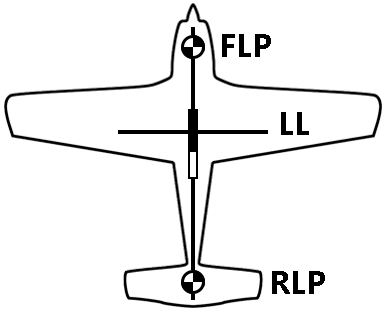
If your drill path requires a consistent depth or to maintain a constant pitch, use the predicted depth feature at the Front Locate Point. This eliminates the need for depth readings over the transmitter, speeding up the drilling process.
Interference can cause incorrect locate data that reduces locating accuracy. There are two different types of interference that can distort the transmitter signal: active and passive.
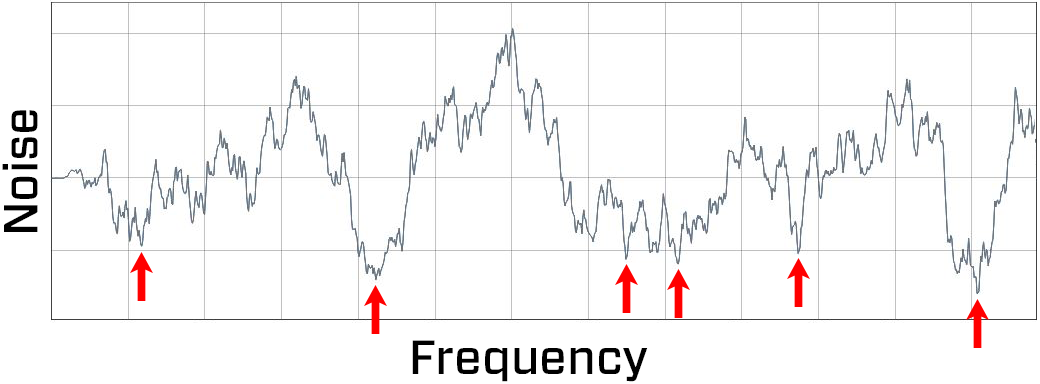
Active interference, or “noise”, consists of anything that emits a signal that interferes with the transmitter signal. Example sources include power lines, radio towers, cathodic protection, fiber tracer lines, invisible dog fences, security systems, and traffic signal loops. Falcon’s frequency optimizer finds the best frequencies to avoid noise.
Passive interference consists of anything that blocks or distorts the transmitter signal resulting in incorrect depths or missing data. Example sources include rebar, guard rails, bridge abutments, chain link fencing, salt/saltwater, and soil high in metal ore. The Falcon sub-kHz transmitter (available for Falcon F5 and F5+ only) helps cut through passive interference without distorting the signal.
An A on the screen can indicate signal Attenuation due to the presence of excessive interference, which can make depth readings inaccurate. Attenuation is normal in shallow depths less than 8 feet (2.4 m). If the signal strength is also flashing, this indicates extreme interference. Depth and locate points may be compromised and the locator will not calibrate.
Noise varies by amount and frequency depending on where you are and even the time of day. That’s why it’s important to find the best frequencies for every bore.
This is called frequency optimization, and only Falcon has it. Using frequencies with the highest probability of success against noise increases locating accuracy and reduces the risk of tripping out.
Falcon’s frequency optimizer scans through hundreds of frequencies, then bundles those with the lowest noise into finely-tuned bands that work best for the current job.
Select two bands and switch between them mid-bore if needed (not available on the Falcon F1 with singleband).
The Falcon Plus locators with Quick Scan Pair offer features to make the selection of bands faster and easier. Two clicks select the two preset bands selected for your region.
Use the trigger switch under the handle of your Falcon F1/F2 to navigate the menu system and select options.
Click to open the Main menu and move between options.
Hold briefly and release to make a selection.
Hold while over the Locate Line (LL) for a depth reading.
Do nothing in a menu for five seconds to return to the Locate Mode screen.
The Locate Mode, Depth, and Predicted Depth screens are the primary screens you will use for locating.
When the locator is detecting a signal from a transmitter, the Locate Mode screen provides real-time data about the transmitter’s location, temperature, pitch, roll, and signal strength.
Depth data appears when the trigger is held at the Locate Line (LL) and predicted depth appears when held at the Front Locate Point.
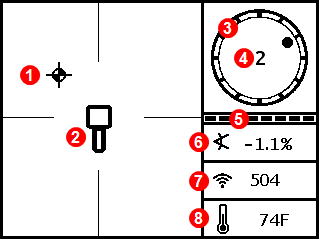
- Locating ball (FLP or RLP)
- Locator
- Roll indicator
- Roll value
- Roll/pitch update meter
- Transmitter pitch
- Power Mode (not available in legacy F1/F2) and Transmitter signal strength
- Transmitter temperature
The Depth screen displays when the trigger is held with the locator at the Locate Line (LL).
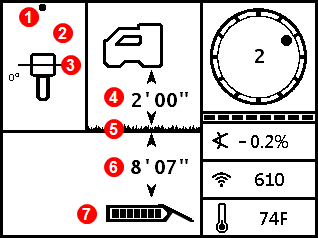
- Locate point (front or rear)
- Bird's-eye view
- Locate Line (LL)
- Height-Above-Ground (HAG) setting on
- Ground level
- Transmitter depth
- Transmitter battery strength

When the HAG setting is disabled, the locator displays at ground level and must be placed on the ground during depth readings.
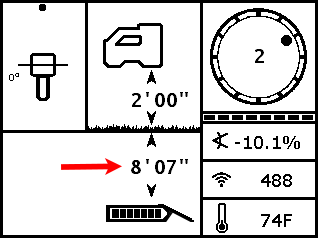
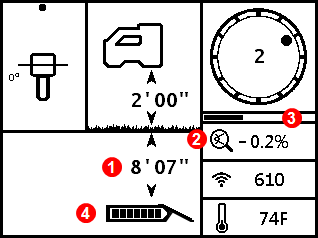
The Predicted Depth screen displays when the trigger is held with the locator at the Front Locate Point (FLP).
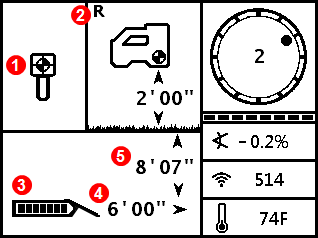
- Ball-in-the-Box at FLP
- Reference Lock indicator *
- Transmitter battery strength
- Horizontal distance between transmitter and FLP
- Predicted depth * of transmitter
The predicted depth is the depth the transmitter is calculated to be at when it reaches the FLP if it continues on its current path.
In this example, if the drill head travels an additional 6'0" (1.82 m) at -0.2% pitch, it will be directly below the locator at 8'7" (2.62 m).

Do not take a predicted depth reading when the locator is over the Rear Locate Point (RLP).
Indicates a reference signal has been obtained for displaying the locate line. Displays at the top of the Locate Mode screen.
The Predicted Depth screen displays when the trigger is held with the locator at the Front Locate Point (FLP). The predicted depth is how deep the transmitter is calculated to be when it reaches the front locate point if it continues on its current path. The predicted depth will also display when the locator is at the Rear Locate Point (RLP), but it will not be correct.
Stuff You Should Know

Registering your equipment activates the product warranty.
Registering also allows us to contact you if it is recovered after being lost or stolen.
If you want to enable the Lock Out Capability (LOC) feature, contact DCI support.
See the DCI website for warranty terms and conditions.
Contact your authorized DCI dealer or DCI to register your equipment.
You will need the equipment serial number and your company contact information.
Here’s where to find your serial number:
- Locator: in the battery compartment
- Transmitter: engraved on the steel body
- Remote display: decal on the back
Check the charge level of your locator battery; each of the five lights on a Li-ion battery represents about 20% capacity.
Insert battery in the locator.
Click to confirm you’ve read the manual.
The regional code for the locator and the transmitter must match. If they don't, contact your DigiTrak dealer.
On the transmitter, look for the globe icon on the etching. The letter or number must match the region code for the locator.

Your transmitter comes with two battery contact springs and one battery cap tool.

Insert batteries positive terminal first. If you are using C-cell batteries, install one spring between batteries to help prevent chatter.

Alkaline batteries are not sufficient for High Power Mode. The locator will display a warning.
Do not use a spring with a SuperCell or the Falcon Tx Adapter (FTA).
The transmitter is powered once batteries or battery adapter is inserted and the cap is installed.
Stuff You Should Know
Use Height-Above-Ground (HAG) to set a height measurement on the locator so you don’t have to put it on the ground for a depth reading.
Raising the locator above the ground also provides separation from underground interference that might otherwise reduce the transmitter’s range or cause variable readings.
Hold the locator at your side as if you were holding a suitcase.
Measure the distance between the ground and the bottom of the locator using a tape measure.
From the Main menu, select HAG.

Click until the locator is shown above the ground along with a question mark (?), then hold to select.
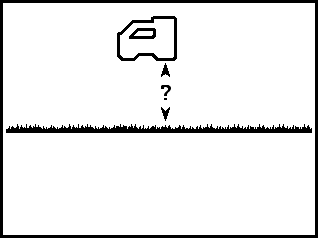
Click to advance to the new height, then hold to select.
HAG is now on.
If you pass the number you want, keep clicking to cycle back around, or wait for the screen to time-out and then try again.

The locator must now be held at the set height for accurate depth readings.
HAG must be turned on manually each time after the receiver is powered on or calibrated.
Check the charge level of your locator battery; each of the five lights on a Li-ion battery represents about 20% capacity.
Insert battery in the locator.
Click to confirm you’ve read the manual.
The regional code for the locator and the transmitter must match. If they don't, contact your DigiTrak dealer.
On the transmitter, look for the globe icon on the etching. The letter or number must match the region code for the locator.
Ensure all transmitters are powered off or more than 100 ft (30.5 m) away from the locator.
From the Main menu, select Frequency optimization.

When the noise bars appear, walk your intended drill path while observing the bars and their high-point markers. Higher bars and markers indicate more noise.
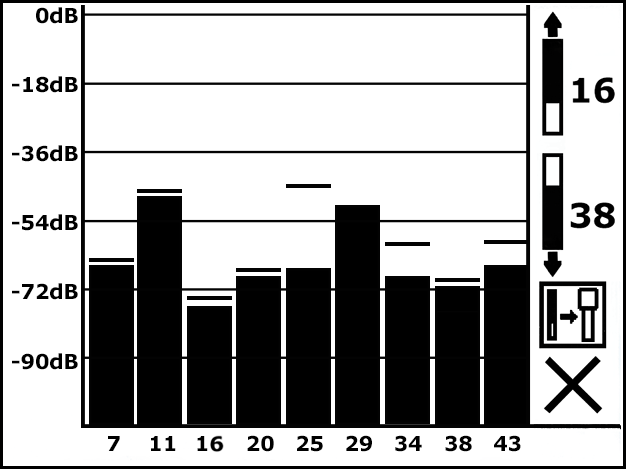
Return to the point of highest noise and re-scan. This gives you the best frequencies for this location.
Hold briefly to select Band 11.

Hold again to assign the new frequencies.
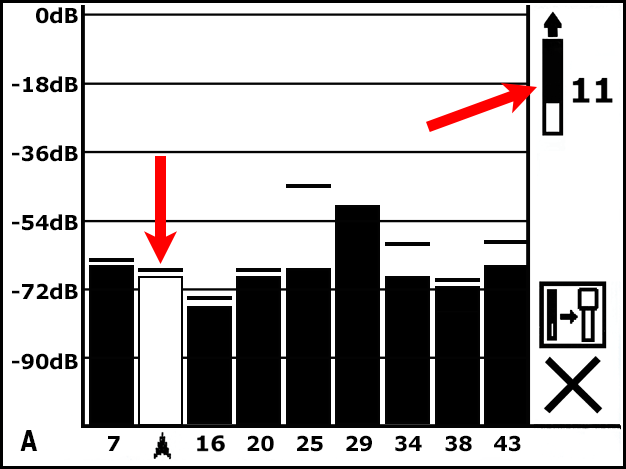
Pairing sends the frequencies you selected to the transmitter. Pair a transmitter immediately after scanning and picking bands.
To pair any other time, from the Main menu select Settings,

Transmitter Options,

Frequency Optimization for Up (or Down) Band, select and reassign the current (or any other) optimized band, and continue here.

Insert battery(ies) positive terminal first and install the battery cap to power on the transmitter.
The FO noise bars will spike when the transmitter is powered on.
Select Pair.

Align the transmitter so its IR port is within five centimetres of and facing the round IR port on the front of the locator.

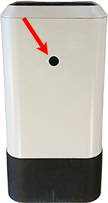
Select the check mark to pair. ✓
The locator beeps and displays a check mark after a successful pairing. ✓
Stuff You Should Know
Calibration is required anytime you change your transmitter, locator, drill head, or perform a new frequency scan and then pair.
Calibrate with the transmitter in the housing flat on the ground in a low-noise, metal-free environment immediately after pairing.
To calibrate any other time, from the Main menu select Calibration, then 1PT CAL before continuing with the following steps.

Install the powered-on transmitter in the drill head and install the cover.
Using a tape measure, place the near edge of the locator parallel to and exactly 10 ft (3 m) from the center of the drill head.
From the Main menu, select Calibration.
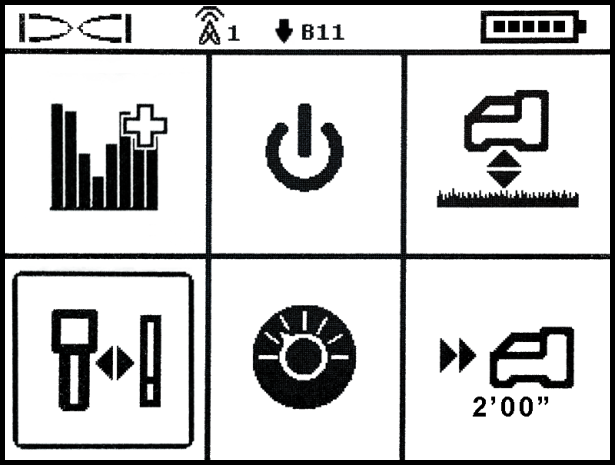
Select 1PT CAL.
Click to calibrate.
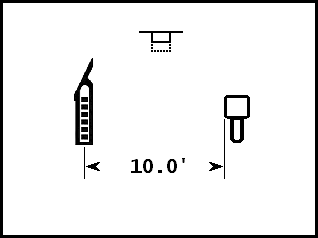
The locator beeps and displays a check mark after a successful calibration.

If you wait longer than about 15 seconds to click the trigger, the calibration terminates and the Above Ground Range (AGR) screen displays.
Use the Above Ground Range (AGR) screen that displays next to check the accuracy of your calibration.
Move the locator to at least two different distances (including maximum bore depth) and verify distance readings match the measurement.
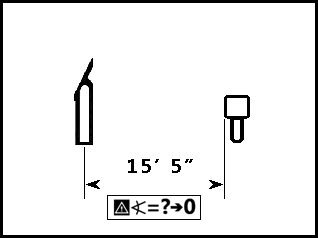
Click to exit to the Locate screen where you will see clock, pitch, and signal strength.
From the Main menu, select HAG.
To enable HAG with the height shown, hold to select. HAG is now on.
To change the height, continue to the next step.
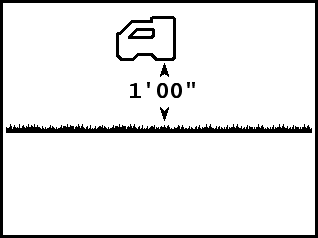
To set a new height, click until the locator is shown above the ground along with a question mark (?), then hold to select. Click to advance to the new height, then hold to set. HAG is now on.
The locator must now be held at this height for accurate depth readings.
HAG must be turned on manually each time after the locator is powered on or calibrated.
Find the Rear Locate Point (RLP)
After the first rod has been drilled in, start at the entry point and face the direction of the bore.
Using the Locate screen, move the locator to put the ball in the box.
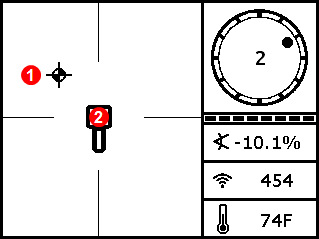
- Ball
- Box
Mark this position on the ground as the Rear Locate Point (RLP).
Find the Front Locate Point (FLP)
Walk forward. As you pass the transmitter, the ball jumps to the top of the screen. You are now tracking the Front Locate Point (FLP).
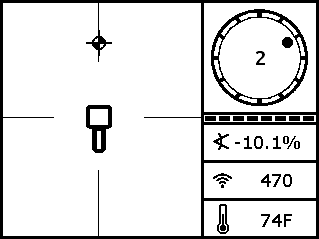
The signal strength increases as you move toward the transmitter and decreases as you move away from it.
An A near the roll indicator indicates signal Attenuation is in effect.
Move the locator to put the ball in the box.
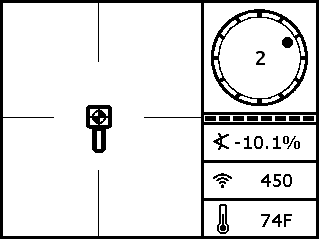
When the ball is centered in the box, hold the trigger for at least one second to lock onto the reference signal. The R icon will appear at the top of the Depth screen. The locate line (LL) will not display later without this reference.
Mark this position on the ground as the Front Locate Point (FLP).
Hold the trigger to show the predicted depth * of the transmitter at this location.
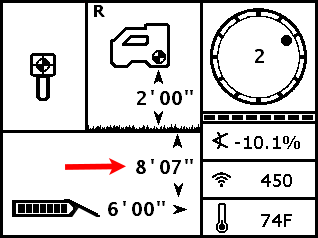
Look back toward the RLP. The drill head is positioned to travel toward you along the line connecting the RLP and FLP.
Find the Locate Line (LL)
Walk back toward the RLP until the Locate Line (LL) appears.
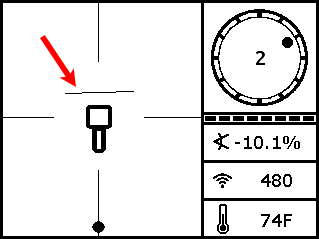
Ensure the locator is on the line connecting the two marked locate points. Position the locator so the LL passes through the center of the box. The drill head should be beneath this point as long as the transmitter is relatively level (see Steep and Deep under Advanced Topics).
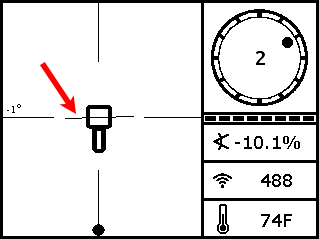
The locator can face toward or away from the drill as long as it is parallel to the direction of drilling.
Hold the trigger to take a depth reading.
If you hold the trigger for longer than five seconds, the locator will enter Max Mode, which can help with unstable data caused by interference or extreme depths.
Continue Locating as the Drill Head Moves
After the drill head moves forward another rod, find the new RLP, FLP, and then the LL.
If the new FLP is in line with the prior locate points (a straight bore line), it is unnecessary to find a new RLP. For a curved drill path, always identify both the FLP and RLP.
If you have a straight drill path but the FLP is to the left or right of the line projected from the previous locate points, this may indicate a drill head deflection or interference affecting the transmitter’s signal.
The Predicted Depth screen displays when the trigger is held with the locator at the Front Locate Point (FLP). The predicted depth is how deep the transmitter is calculated to be when it reaches the front locate point if it continues on its current path. The predicted depth will also display when the locator is at the Rear Locate Point (RLP), but it will not be correct.
Select power icon in the Main menu to power off the locator.

Remove the battery and inspect its contacts and those inside the battery compartment for corrosion and debris. Clean and charge as needed.
Wipe the locator clean. Use only an abrasive-free cleaner and soft cloth to clean the screen.
Do not pressure wash.
Store the battery and locator in the original system carry case safe from impact, moisture, and excessive temperatures.
Do not store the battery in the battery charger or locator.
Storage and transportation temperature must remain within -40° – 149°F (-40° – 65°C).
Remove the transmitter from the drill head.
Wipe the transmitter clean so dirt doesn’t enter the battery compartment or accumulate on the battery cap threads.
Remove the transmitter batteries to power it off.
The transmitter records active run-time for warranty purposes. Sleep mode is not counted.
Inspect the battery compartment, springs, cap, O-ring, battery adapter, and threads for debris. Clear any debris and replace the battery cap.
Use conductive lubricant on the threads if the battery cap is difficult to turn.
Store batteries so they do not contact metallic objects or terminals of other batteries.
Store the transmitter in the original system carry case where it will be safe from impact and excessive temperatures.
Storage and transportation temperature must remain within 40° to 149° F (-40 to 65 °C).
When a transmitter is level (zero pitch) underground:
- the locate points (FLP and RLP) are at equal distances from the transmitter
- depth displayed on the locator is the actual depth, and
- the Locate Line (LL) indicates a position above the transmitter.
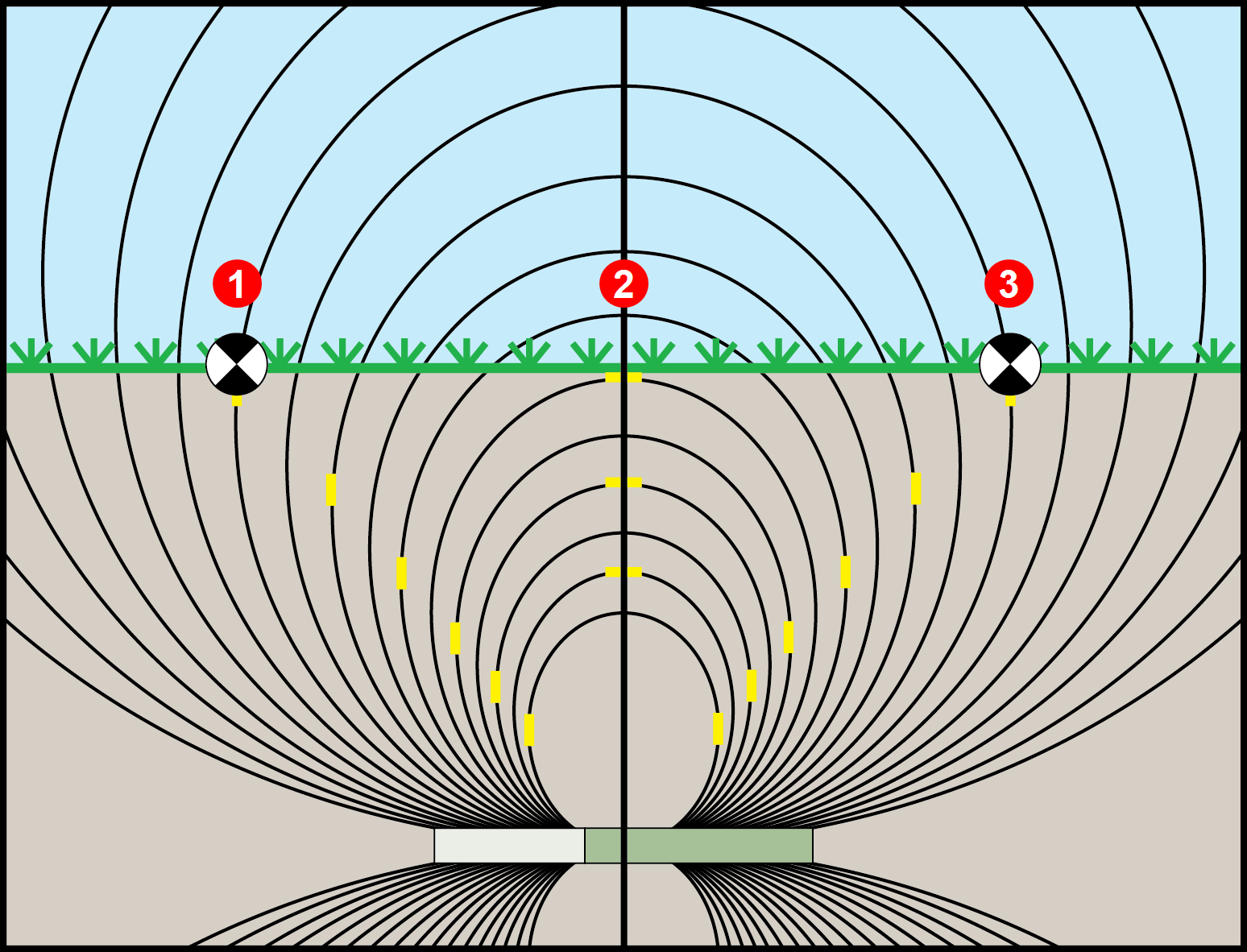
- RLP
- LL
- FLP
When the transmitter is pitched up or down, the transmitter signal field also tilts.
When the transmitter is pitched down (negative pitch), the locate line on the screen reflects a future position of the transmitter, assuming the transmitter stays on the same trajectory (projected depth).
When the transmitter is pitched up (positive pitch, shown below), the locate line on the screen reflects a position behind the transmitter.
The depth reading on the locator is based on the projected depth point, which is not the same as the actual depth of the transmitter.
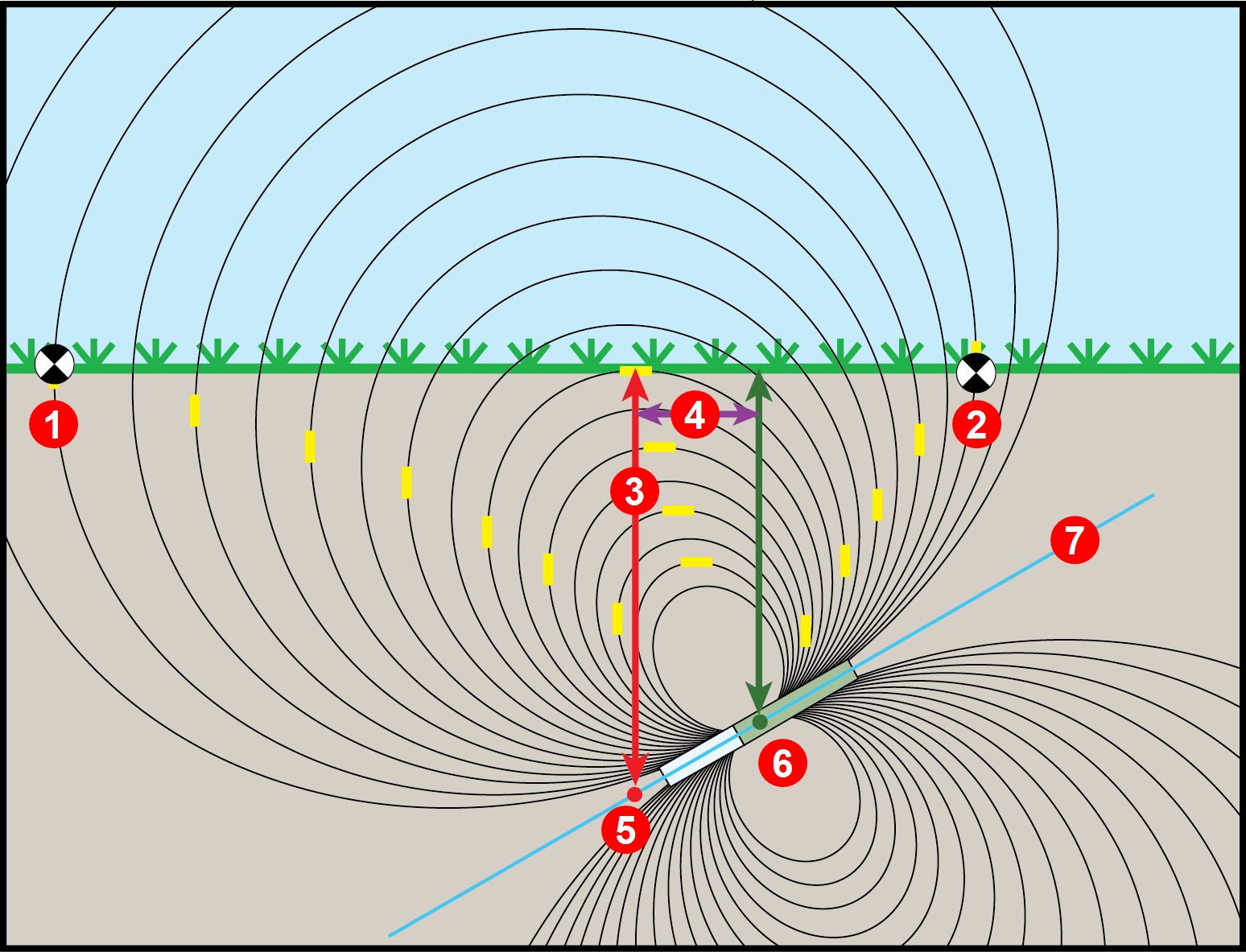
- RLP
- FLP
- LL
- Fore/aft offset
- Projected depth
- Transmitter at positive pitch
- 30% (17°)
The differences in position and depth between the projected depth point and the actual location of the transmitter can be relatively small at low pitch and/or shallow depth.
When drilling at a steep pitch and/or significant depth, the differences are greater.
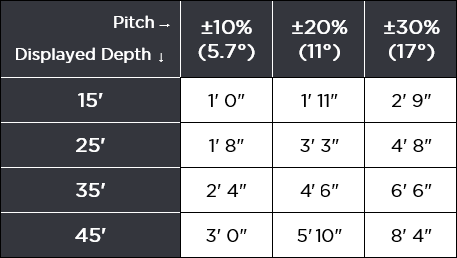
For example, if the transmitter is at a plus or minus 30% pitch and a 33'1" (10.1 m) depth, the locator depth reading will be 35' (10.7 m) (just under 6% difference from actual depth) and the locate line will be 6'6" (2 m) from being directly above the transmitter (-30% places the LL ahead and +30% places the LL behind).
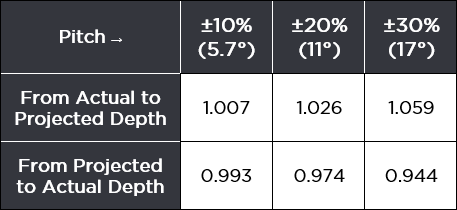
You can use the pitch and the projected depth reading on your locator to determine the actual depth and the position (fore/aft) of the locate line:
Actual Depth
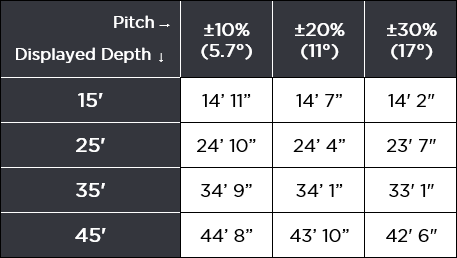
Fore/Aft Offset
For a given pitch, you can calculate actual or projected depth:
This calibration procedure is rarely needed. If you find it necessary to calibrate with the transmitter in the ground, contact DCI customer service for information on this option, and perform the procedure with caution.
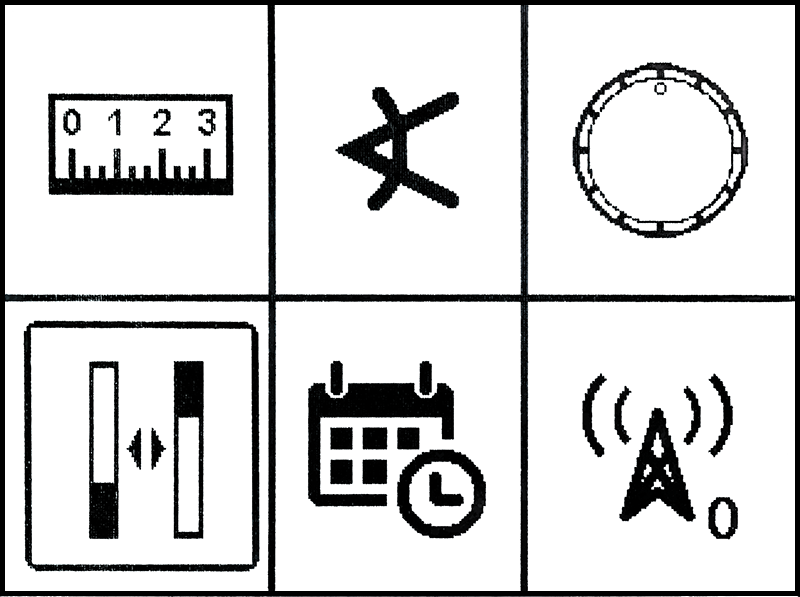
From the Main menu, select Settings.
Select Transmitter Options.
Align the transmitter so its IR port is near and facing the round IR port on the front of the locator.
Select Transmitter Info.
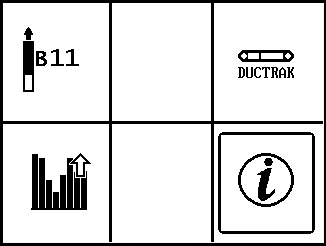
Use the Transmitter Info screen to check important information such as runtime hours for warranty coverage, current band, operating current *, battery voltage *, and max recorded temperature.
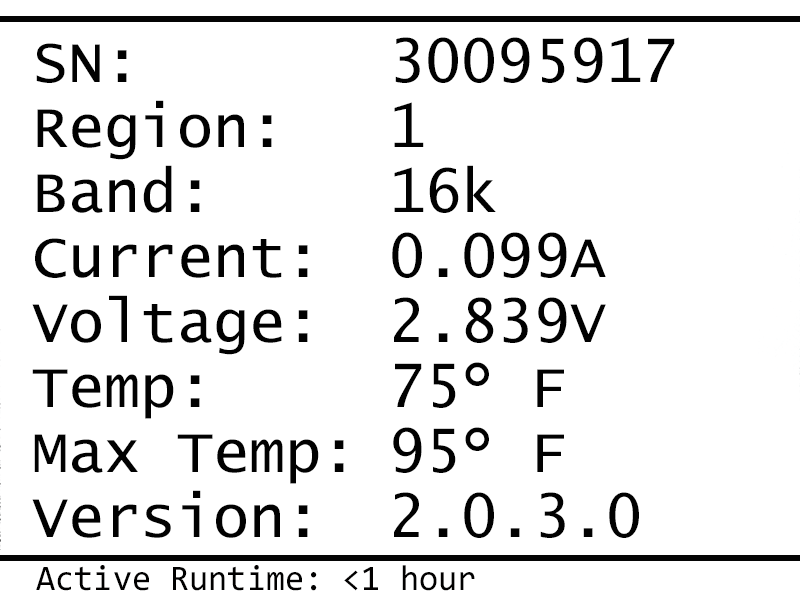
Click to return to the Locate Mode screen.
A reading of greater than 0.50 A or less than 0.05 A indicates electrical failure.
A voltage reading below 2.7 (alkaline), 3.2 (lithium) or 3.9 (LiR) indicates bad or depleted batteries.
DigiTrak transmitters (Tx), with the exception of DucTrak, have temperature overheat indicators (temp dot) on the front end cap.
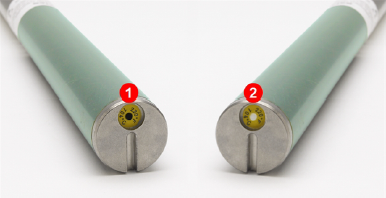
- Black temp dot (voids warranty)
- Normal white temp dot
The temp dot has an outer yellow ring with a temperature-sensitive 1/8" white dot in the center. If the center temp dot is black, the transmitter has been exposed to excessive heat and should no longer be used.
The DCI Warranty does not cover any transmitter that has been overheated or had the temp dot removed.
DigiTrak transmitters (Tx), with the exception of DucTrak, have an internal digital thermometer. The normal below ground temp range is 63° – 104°F (17° – 40°C). The Tx temperature displays on the bottom right of the locator screen and remote display screens.
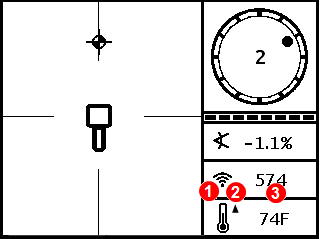
- Temperature status icon
- Temp trend up/down arrows
- Temperature
Suspend drilling when temperatures increase rapidly. Temperatures above 111°F (36°C) are not typical.
As the transmitter (Tx) temperature increases above 61°F (16°C), the locator and remote emit warning beeps and the temperature icon changes on the locator or remote display.
Tx temp: 61° – 97°F (16° – 36°C)

Warning tones: Warning tones: Double beep (Beep-beep) for every 7°F (4°C) increase.
Watch for an upward trend in temperatures.
Tx temp: 104° –111°F (40° – 44°C)

Warning tones: Two double beeps (Beep-beep; Beep-beep) for every 7°F (4°C) increase.
Cool the transmitter.
Tx temp: 118° – 133°F (48° – 56°C)

Warning tones: Three double beeps (Beep-beep, Beep-beep, Beep-beep) for every 7°F (4°C) increase.
Cooling is critical to avoid irreversible damage.
Tx temp: 140° F (60°C) and above (icon flashing)
Warning tones: Three double beeps (Beep-beep, Beep-beep, Beep-beep) for every 20 seconds on the locator and 5 seconds on the remote display.
The transmitter has been exposed to dangerous drilling conditions. Temperatures above 185°F (85°C) may cause irreversible damage to the transmitter.
The transmitter records the maximum temperature that it has been exposed to. Use the Transmitter Info screen to view this information. See the "Get Transmitter Info" article for steps.
Before You Get Started
Max Mode can stabilize roll/pitch data and depth readings when drilling at the transmitter’s range limit due to extreme depth or interference, which will vary by jobsite. Use when the roll/pitch update meter shows low signal level or data is unstable.
The drill head must be stationary when taking readings using Max Mode. If the drill head is moving, data readings will not be accurate.
You will typically use Max Mode in areas where interference is high. In areas of high interference, it will be harder to obtain stable readings. Never rely on unstable depth or data. Max Mode is not a substitute for prudent operator judgment.
At the Locate Mode screen, hold the trigger for longer than five seconds to enter Max Mode.

Continue holding the trigger until depth and data stabilize.
If the Max Mode timer fills up before depth and data stabilize, move to a different location near the drill head and hold to restart.
The timer bar will fill as data is confirmed.
- Depth
- Max Mode icon
- Max Mode timer
- Transmitter battery strength
Take two more Max Mode readings. All three readings must be consistent.
If the readings are not consistent, change the band and try again. If the readings continue to be inconsistent, turn the locator off and then on again. If the issue continues, contact DCI Customer Support.
Before You Get Started
The Target Steering guidance method allows the Falcon locator to be placed ahead of the drill head and used as a steering target.
Use it to distance the locator from rebar that is causing signal interference and to drill where walkover locating is not possible.
Target Steering is typically only used on a straight drill path under level ground, not a curved path, with terrain changes, or to correct a significantly off-course bore.
The maximum distance the locator can be placed ahead of the drill head for Target Steering is 35 ft (10.7 m).
Within this range, starting with the drill head approximately level, the maximum depth and pitch changes are approximately 10 ft (1.2 m) and 14%, respectively.
Beyond this distance, depth information becomes less accurate.
Data and left / right steering is usable for the entire range of the transmitter.
Any Height-Above-Ground (HAG) setting is ignored by the locator when Target Steering is used.
Target Steering is not supported by the Falcon Compact Display.
From the Main menu, select Target Steering.

The screens in this process time out after 4 seconds of no trigger action.
To use the previously set target depth, hold the trigger at the first screen, otherwise continue with the following steps to set a new target depth.
Click twice to advance to the set target depth * screen. Hold the trigger briefly to select.
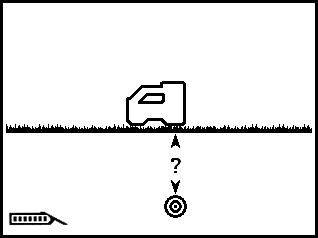
HAG is not factored into the target depth setting. Elevate the locator and add that height to the target depth if drilling shallower than 1.5 ft (46 cm) or if elevating the locator to distance it from rebar.
Hold briefly to change the cursor to a box. Click to scroll through numeric values. Then hold briefly to set.
Click to move the cursor to the next digit, hold briefly to select, click to change, and hold again to set.
When the desired target depth number is shown, click to underline the check mark and then hold to set.
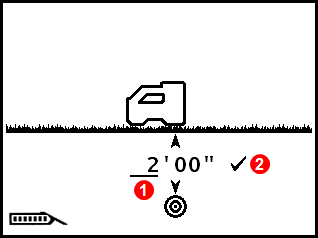
- Current selection
- Select to confirm setting when done
If you click past your desired value, wait about five seconds to exit without saving and try again.
Place the locator on the drill path with its battery compartment facing the drill head. Target Steering guides the transmitter to be inline with the locator's handle when it reaches the target beneath the locator. For accurate depth information, use the horizontal distance reading on the Target Steering display to ensure the locator is no more than 35 ft (10.7 m) in front of the transmitter.
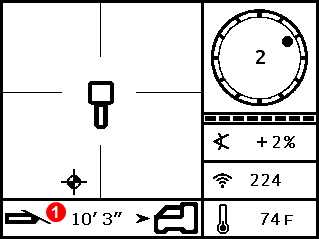
- Horizontal distance from transmitter to locator
At this point, the drill rig operator uses the remote display to drill to the target.
When the Front Locate Point passes the locator, move the locator farther out to continue Target Steering.
If the drill head passes this point, depth and horizontal distance values on the Aurora become invalid.
To turn off Target Steering, select the Target Steering menu from the Main menu.

Click once, then hold to turn off Target Steering and return to the Locate Mode screen.

A value programmed into the locator, so it can be positioned ahead of the transmitter housing and used as a steering target. The value programmed should be the desired depth of the transmitter when it reaches the point below the locator. If a locator is placed above ground level, such as to provide separation from interference, that height must be added to the target depth.
Note: If using a Falcon Compact Display, only left/right steering information is available. The locator used with the Falcon Compact Display must still have a target depth set. This target depth can be any value.
Depth Increase in Inches (cm)
| % slope | Depth increaseinches (cm) | % slope | Depth increase inches (cm) |
|---|---|---|---|
| 31 | 36 (91) | 43 | 47 (119) |
| 32 | 37 (94) | 44 | 48 (122) |
| 33 | 38 (97) | 45 | 49 (124) |
| 34 | 39 (99) | 46 | 50 (127) |
| 35 | 40 (102) | 47 | 51 (130) |
| 36 | 41 (104) | 50 | 54 (137) |
| 37 | 42 (107) | 55 | 58 (147) |
| 38 | 43 (109) | 60 | 62 (157) |
| 39 | 44 (112) | 70 | 69 (175) |
| 40 | 45 (114) | 80 | 75 (191) |
| 41 | 46 (117) | 90 | 80 (203) |
| 42 | 46 (117) | 100 | 85 (216) |
Slopes between 50% and 100% are provided for reference only and do not represent typical drilling conditions. All numbers are based on math only and do not take into account extremely soft or extremely hard soil conditions, which may cause depth values to vary.
Depth Increase in Inches (cm)
| % slope | Depth increase inches (cm) | % slope | Depth increase inches (cm) |
|---|---|---|---|
| 1 | 2 (5) | 16 | 28 (71) |
| 2 | 4 (10) | 17 | 30 (76) |
| 3 | 5 (13) | 18 | 32 (81) |
| 4 | 7 (18) | 19 | 34 (86) |
| 5 | 9 (23) | 20 | 35 (89) |
| 6 | 11 (28) | 21 | 37 (94) |
| 7 | 13 (33) | 22 | 39 (99) |
| 8 | 14 (36) | 23 | 40 (102) |
| 9 | 16 (41) | 24 | 42 (107) |
| 10 | 18 (46) | 25 | 44 (112) |
| 11 | 20 (51) | 26 | 45 (114) |
| 12 | 21 (53) | 27 | 47 (119) |
| 13 | 23 (58) | 28 | 49 (124) |
| 14 | 25 (64) | 29 | 50 (127) |
| 15 | 27 (69) | 30 | 52 (132) |
| % slope | Depth increase inches (cm) | % slope | Depth increase inches (cm) |
|---|---|---|---|
| 31 | 53 (135) | 43 | 71 (180) |
| 32 | 55 (140) | 44 | 72 (183) |
| 33 | 56 (142) | 45 | 74 (188) |
| 34 | 58 (147) | 46 | 75 (191) |
| 35 | 59 (150) | 47 | 77 (196) |
| 36 | 61 (155) | 50 | 80 (203) |
| 37 | 62 (157) | 55 | 87 (221) |
| 38 | 64 (163) | 60 | 93 (236) |
| 39 | 65 (165) | 70 | 103 (262) |
| 40 | 67 (170) | 80 | 112 (284) |
| 41 | 68 (173) | 90 | 120 (305) |
| 42 | 70 (178) | 100 | 127 (323) |
Slopes between 50% and 100% are provided for reference only and do not represent typical drilling conditions. All numbers are based on math only and do not take into account extremely soft or extremely hard soil conditions, which may cause depth values to vary.
Contact
DCI USA
19625 62nd Ave S, Suite B103
Kent, WA USA 98032
DCI@digital-control.com
1.800.288.3610
1.425.251.0559
DCI Australia
2/9 Frinton Street Southport
Queensland 4215 Australia
DCI.Australia@digital-control.com
+61.7.5531.4283
+61.7.5531.2617
DCI China
368 Xingle Road Huacao Town
Minhang District Shanghai 201107, P.R.C
DCI.China@digital-control.com
+86.400.100.8708
+86.21.6432.5186
DCI Europe
Brueckenstraße 2
97828 Marktheidenfeld Germany
DCI.Europe@digital-control.com
+49.9391.810.6100
+49.9391.810.6109
DCI India
Unit No. 1022, 10th Floor DLF Tower B Jasola District Center
New Delhi 110025 India
DCI.India@digital-control.com
+91.11.4507.0444
+91.11.4507.0440
DCI Philippines
404-405 Energy Opt. Bldg Prime St, Madrigal Business Park 2
Alabang Muntinlupa City, Philippines 1780
DCI.Philippines@digital-control.com
(02)79802647
+632-79802647